
I first came across the term anxious attachment several years ago. Being in the personal development and mental wellness space means you encounter a lot of this language over time. But the more I sat with it, the more I realized my relationship with anxious attachment wasn’t quite what most people picture when they hear it.
For a lot of people, anxious attachment means clinging to a partner. And yes, that’s part of it. But my experience was different. My attachment was to patterns and behaviors, not necessarily to a person. Things I knew weren’t good for me that I kept returning to anyway, driven by a kind of restless anxiety I couldn’t quite name.
The clearest example for me was sleep. I’ve struggled with insomnia for decades and written about it extensively here. I knew that working on the blog late into the evening was keeping my brain far too active before bed. I knew it. And I kept doing it. Not because I needed to. But because stepping away created an anxiety I didn’t know how to sit with. That’s anxious attachment. Not always to a person. Sometimes to a habit, a pattern, a behavior that feels safer than the discomfort of letting go.
If any part of that resonates with you, this is for you.
What Is Anxious Attachment?
Anxious attachment is one of the four main attachment styles identified by psychologist John Bowlby and later expanded by researchers Mary Ainsworth and Amir Levine. Attachment styles are the patterns we develop in early relationships that shape how we connect, bond, and respond to closeness throughout our lives.
The four styles are: secure, anxious, avoidant, and disorganized. Anxious attachment is characterized by a deep fear of abandonment, an intense need for reassurance, and a nervous system that reads ordinary distance or uncertainty as a threat.
People with an anxious attachment style often feel most comfortable when they are close, when they can feel the connection, when they know the bond is there. When that reassurance isn’t available, anxiety fills the space.
And here is what most articles miss: anxious attachment doesn’t only show up in romantic relationships. It shows up in how we relate to our work, our habits, our phones, our routines, and the patterns we keep returning to even when we know they’re not good for us.
Table of Contents

What Anxious Attachment Actually Feels Like From the Inside
This is the part most clinical articles skip entirely. They describe anxious attachment in terms of behaviors. But if you want to know whether this is you, you need to know what it feels like.
Anxious attachment from the inside is a pressing, gnawing feeling. Like something is not quite right, and until you fix it or find it or reach for it, the feeling won’t stop. You do what you know you’re not supposed to do out of a kind of FOMO, or a fear of boredom, or loneliness. The anxiety kicks in and you grip for dear life, because if you don’t grip you might lose the thing entirely and end up with even greater anxiety or a full-blown spiral.
So you latch on. To the relationship. To the habit. To the behavior. To whatever it is that quiets the gnawing, even temporarily.
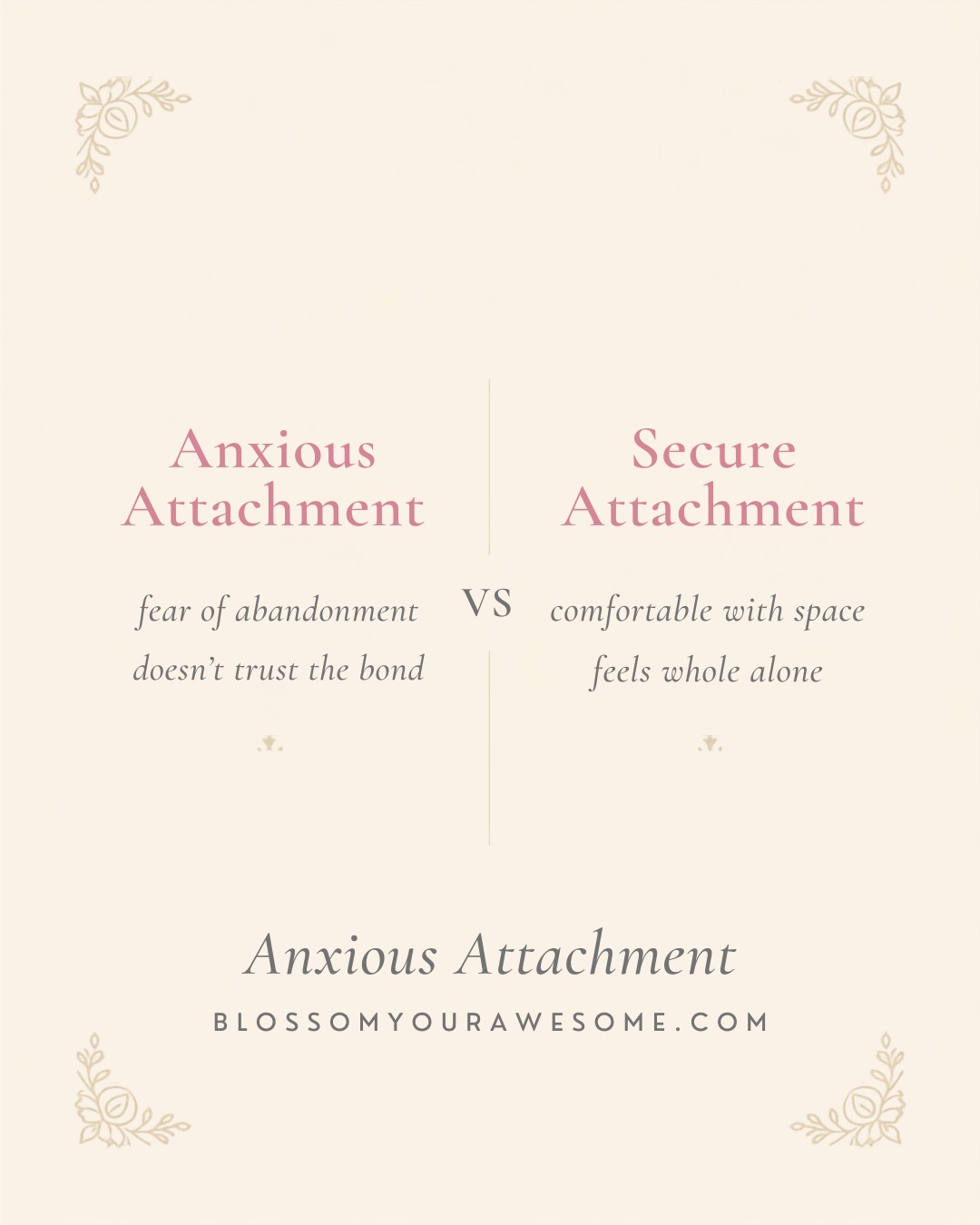
When you are in a secure place with yourself, or in a healthy relationship, you don’t clench. You understand that space and time apart are healthy. You see them as evidence of trust, not threat. But with anxious attachment, that space feels dangerous. It feels like loss. And the nervous system responds accordingly.
Women with anxious attachment often describe:
- A constant low-grade anxiety in relationships that only quiets when they have reassurance
- Checking their phone repeatedly waiting for a text back
- Feeling like they need to stay close, stay connected, stay visible to the person or thing they’re attached to
- Doing things they know aren’t healthy because stopping creates more anxiety than continuing
- A deep fear that if they let go even slightly, the whole thing will slip away
- Difficulty being alone without reaching for something to fill the space
Why Anxious Attachment Is Not the Same as Loving Someone Deeply
This distinction matters enormously, and most people get it wrong.
Wanting to always be with someone can look like deep, devoted love from the outside. But there is a difference between love and need, between connection and gripping.
The clearest sign is what happens in your body. Genuine love feels safe. It feels grounded. When you love someone deeply and securely, you feel safe in their company and you feel safe outside of it. You don’t spiral when they don’t text back immediately. You don’t catastrophize when they need space. You can care about someone deeply and also exist fully when they’re not present.
Anxious attachment feels different. Anytime anxiety kicks in, that’s a signal. That’s your nervous system telling you something. Not that the love isn’t real, but that the fear underneath it is running the show.
Loving someone deeply means giving them space because you understand that space is not absence. It’s healthy. You can love someone from a distance and feel safe in the bond. The distance is not a measure of the love. It’s an extension of it. Two people who feel whole on their own, who choose each other from a place of fullness rather than fear, create something entirely different from two people gripping each other out of need.
Signs of Anxious Attachment in Real Life
Anxious attachment shows up in recognizable patterns once you know what to look for. Some of these will feel very familiar.
In relationships: Clingy behavior, not giving a partner space, needing constant reassurance that things are okay. Always saying yes out of fear of what it means if you say no. Agreeing when you don’t actually agree because conflict feels threatening. Checking on someone more than the situation warrants. Interpreting a slow response as a sign something is wrong.
In your habits and routines: Returning to behaviors you know aren’t serving you because stepping away creates too much anxiety. Working when you should be resting. Scrolling when you’d rather stop. Staying attached to a pattern because it feels safer than the discomfort of changing it.
In friendships: Needing to be needed. Feeling anxious when a friend is unavailable. Reading normal distance as rejection.
In your relationship with yourself: Struggling to be alone without filling the silence. Discomfort with stillness. Difficulty sitting with uncertainty without reaching for something to soothe it.
The common thread through all of it is the same: anxiety drives the attachment, and the attachment temporarily quiets the anxiety. Until it doesn’t. And the cycle continues.
Where Anxious Attachment Comes From
Anxious attachment is something most people develop early. Sometimes as early as childhood.
Perhaps you were abandoned or neglected at a formative age. Perhaps you had a parent who was clingy or emotionally needy themselves, who required you to constantly affirm your love to them, and so you learned that relationships require this kind of vigilance to survive. Or perhaps you never received the love and nurturing you needed, and you moved into adulthood craving it, gripping it when you found it, terrified that it would be taken away just like it was before.
A parent who left. A caregiver who was inconsistently available. A household where love felt conditional. All of these can wire a nervous system to conclude: connection is precious, fragile, and can disappear at any moment. I must hold on tight.
As adults we repeat those patterns. The child who feared abandonment becomes the adult who cannot tolerate uncertainty in relationships. The nervous system is not being irrational. It is responding to what it learned. It just hasn’t received the update that things are different now. Want to learn to stop fawning go here and if you’ve got the tendency to people please let’s address that right now right here.
The Part Nobody Talks About: Anxious Attachment to Things, Not Just People
Almost every article about anxious attachment focuses exclusively on romantic relationships. But this is a much broader pattern than that.
You can be anxiously attached to your work and unable to step away from it even when it’s costing you sleep. You can be anxiously attached to your phone, to social media, to a habit or substance, to a way of thinking about yourself or the world. Any pattern you keep returning to despite knowing it isn’t serving you, driven by an anxiety that kicks in when you try to stop, is worth examining through this lens.
This was my entry point into understanding anxious attachment. Not a relationship. A behavior. The late nights working when I needed rest. The inability to close the laptop because my brain didn’t know what to do with the silence. Understanding it as anxious attachment rather than just a bad habit changed how I approached it. Because habits are easy to dismiss. Anxious attachment patterns require something deeper.
How to Heal Anxious Attachment
Healing from anxious attachment is about becoming whole within yourself. Not independent in a cold, closed-off way. But genuinely complete, so that what you reach for comes from love and want rather than fear and need.
Here is what that journey looks like in practice:
Do the inner work. Healing anxious attachment requires looking honestly at the early experiences that created it. This is not about blame. It’s about understanding. When you know where the pattern came from, you can begin to address it at the root rather than just managing the symptoms. [LINK: shadow work post]
Build a relationship with yourself first. This means learning to be with yourself without always needing to fill the space. Starting small: a walk without your phone, a morning without jumping straight to work, a quiet evening that you don’t escape. The goal is to discover that you can exist in stillness without catastrophe.
Recognize the difference between need and choice. Healing looks like wanting someone in your life without feeling like you cannot survive without them. It looks like choosing to be in a relationship or maintain a habit from a place of genuine desire rather than anxious compulsion. That shift, from desperation to choice, is significant.
Nurture yourself the way you needed to be nurtured. A lot of anxious attachment comes from love and safety that was absent early on. Part of healing is learning to provide that for yourself: consistency, gentleness, reliability. You become the steady presence for yourself that you needed and didn’t always have.
Work with a therapist. Attachment patterns run deep and doing this work with professional support accelerates everything. A therapist who understands attachment theory can help you identify your patterns, understand their origins, and build new ways of relating. If you’re not sure where to start, BetterHelp connects you with licensed therapists online and removes the logistical barriers that often get in the way of making that first appointment. How much does BetterHelp cost?
Know that secure attachment is learnable. You were not born anxiously attached. You developed this pattern in response to your environment. That means you can develop a different pattern. Secure attachment is not only for people who had a perfect childhood. It is available to you, through the work, through good relationships, through choosing to heal.
Getting Help With Your Anxious Attachments
As you know I am a huge proponent of mental wellness and ensuring we all get the help we need when we need it. And of course I do not want you just to get any help, I want you to get the right help, so I am now sponsored by BetterHelp.
BetterHelp is the world’s largest therapy service and it is 100% online.
BetterHelp offers a network of over 25,000 licensed and experienced therapists who can help you with a wide range of issues.
Just click on the link below, answer a few questions and get matched with a therapist from the network.
One of the most amazing features of BetterHelp: if you do not jive with your therapist you can switch to a new one that is a better fit for you any time free of charge.
With BetterHelp you get the same professionalism and quality you expect from in-office therapy, but with a therapist who is custom-picked for you, more scheduling flexibility, and at a more affordable price.
To the Woman Who Just Recognized Herself
If you’ve seen yourself in these words, I want you to know something.
You are not broken. You are not too much. You are not fundamentally flawed or incapable of healthy love. You developed this pattern because at some point in your life it was the only way you knew how to hold on to something precious. That made sense then. It doesn’t have to be the only way now.
There is love that does not feel like gripping. There is connection that does not feel like holding your breath. There is a way of being in relationship, with other people and with yourself, that feels centered and whole and safe. You feel it in your bones rather than having to convince yourself of it.
That is not just possible for other people. It is possible for you too.
Frequently Asked Questions About Anxious Attachment
What is anxious attachment? Anxious attachment is an attachment style characterized by a fear of abandonment, a need for constant reassurance, and an anxious response to distance or uncertainty in relationships. It develops in early life and shapes how we connect with others and ourselves into adulthood.
What are the signs of anxious attachment? Common signs include clinginess in relationships, difficulty giving a partner space, constant need for reassurance, interpreting normal distance as rejection, fear of abandonment, agreeing with others out of anxiety rather than genuine agreement, and returning to unhealthy patterns because stepping away creates too much discomfort.
What causes anxious attachment? Anxious attachment typically develops in childhood in response to inconsistent, absent, or emotionally needy caregiving. When a child cannot reliably predict whether their need for love and safety will be met, the nervous system learns to grip tightly to connection whenever it’s available.
Is anxious attachment only about romantic relationships? No. While anxious attachment most visibly shows up in romantic relationships, it also appears in friendships, work habits, routines, and behavioral patterns. Any pattern you keep returning to despite knowing it isn’t serving you, driven by an anxiety that kicks in when you try to stop, may have an anxious attachment component.
How is anxious attachment different from loving someone deeply? Genuine love feels safe. You feel secure with someone and secure without them. Anxious attachment involves anxiety driving the connection: fear of abandonment, fear of space, fear of what it means if things aren’t constantly close and confirmed. The clearest indicator is whether your nervous system relaxes in the relationship or stays on alert.
Can anxious attachment be healed? Yes, completely. Anxious attachment is a learned pattern, not a fixed personality trait. With self-awareness, inner work, and often therapeutic support, it is possible to develop secure attachment and relate to others from a place of wholeness rather than fear.
What is the opposite of anxious attachment? Secure attachment. People with secure attachment feel comfortable with both closeness and independence. They trust that relationships can handle distance and disagreement. They choose connection from a place of genuine want rather than anxious need.
Have you recognized anxious attachment in yourself? Leave a comment below. And if this resonated, please share it with someone who needs to hear it.