
If you have ever felt not heard, not safe in expressing your own feelings, vulnerable and alone, I know exactly how you feel because healing from emotional neglect stays with you.
I had so much love inside of me that I was never able to fully express because of the insecurities of others, or the needs of someone who had to make everything about himself at every turn. I know what it’s like to be dismissed as if you don’t exist, or told to turn off your feelings for someone else’s comfort. I’ve been there, idling in my own woes and despair, and it’s an awful feeling.
But counter to this is another magical idea: that our feelings are valid, and that expressing yourself deeply and from the heart matters, and ultimately will set you free. Whether it’s learning mindful communication and going deeper with the people around you, or finding a therapist who can lead you to healing, you should know that wholeness in some capacity awaits. You are worthy of feeling good and whole again.
This is the post I wish someone had handed me years ago. If you are searching for real, honest healing from emotional neglect, and not just another checklist, you are in the right place.

Table of Contents
What Emotional Neglect Actually Is
I’m a very feeling being. Emotions are everything to me. So when our feelings get dismissed, it hurts. We feel a deep sense of neglect.
Emotional neglect is something we’ve all felt at some point, but not all of us are as feeling, and not all of us were ever taught to acknowledge our feelings. Or perhaps it’s that many of us didn’t feel safe acknowledging or expressing our feelings in the first place. Whatever you want to call it, dismissiveness, invalidation, being talked over, it all falls under the umbrella of emotional neglect.
That’s the part people miss. The APA Dictionary of Psychology describes emotional neglect as a failure to provide comfort, attention, or emotional support, an act of omission rather than a single harmful act. Emotional neglect isn’t always a dramatic story. Sometimes it’s just never being asked how you feel. Sometimes it’s being taught, quietly and consistently, that your feelings are inconvenient. Whether it shows up as childhood emotional neglect or emotional neglect in adulthood, the impact tends to feel the same: you learn to make yourself smaller so someone else can feel comfortable.
If you want to go deeper on the mental health side this Mental Wellness guide is a good next stop.
The Day I Was Told Not to Cry
One of the first times I felt emotionally neglected, someone told me not to cry in their presence.
I was in the middle of a considerable breakdown when he walked in. I won’t say who he is. My own tears triggered something uncomfortable within him, causing him to react and shut down my emotions.
I felt so deeply hurt I can go as far as saying traumatized. When we are in the heat of a moment, in a space of despair, the last thing we need is someone telling us to turn those feelings off. What we really need is acknowledgment, consideration, care, consolation. Most of us just need someone fully present and willing to offer a compassionate ear.
I realized my feelings were being dismissed completely, shut down, and that was an awful feeling. I didn’t quite know how to respond, but I did my best to honor the person. I collected myself to the best of my abilities. Gathered my things. Left. And then had a total breakdown in the car. This time I was crying for more reasons than one. That single moment taught me more about emotional neglect than any book ever could.
If this resonates, my conversation with Susan Partnow of the Compassionate Listening Project, Episode #9 of the Blossom Your Awesome Podcast, is one of my most downloaded episodes ever. Be sure into my conversation and powerful insights on Compassionate Listening.
How It Shows Up: Growing Up, and Later in Love
Growing up, my parents were always very thoughtful and mindful of my feelings. That’s perhaps why encounters with others who weren’t felt so abrasive, harsh, and hard to handle. I never had an issue expressing my feelings, I just encountered people who had issues with it, and that is a troubling thing to go through. Our feelings are there for a reason and need to be acknowledged. This is what emotional neglect in relationships can look like: not always cruelty, sometimes just an inability to hold someone else’s feelings.
Into adulthood, as I’ve continued doing the work, exploring, learning, being inquisitive, I’ve gained a lot of insight into emotions, regulation, feelings, listening, and presence. This brings me to an episode with psychologist Dr. Fred Moss, who says that most of us simply don’t have people in our worlds who honor us, because if we did, we wouldn’t need therapy. What we need as human beings is to know we are loved, to be heard, to be able to express ourselves without judgment. We just need someone in our corner. That compassionate ear.
That conversation is packed with powerful guidance. Listen to the episode with Dr. Fred Moss here.
In one particular relationship, I learned the power of listening the hard way. I sensed my words were getting me nowhere, so I learned to listen and selflessly allowed this other person, who just so happened to be a narcissist, to speak at me. It didn’t do much for me in that particular circumstance. But in that quietude, I learned that listening could be truly powerful. If you listen to someone who actually cares, who is kind and considerate, someone you love who loves you back, you can go places with them you never could unless you listened deeply.
That comes right back to feelings and expression, and how allowing others to share at length gives you a piece of themselves you’d never receive unless you showed up for them that way. Those long bouts of listening filled my ears and my heart with a sense of compassion and opened me up in ways I didn’t even know were possible. It did the same for the other person whose heart I was honoring with my compassionate listening.
I came to this conclusion nearly two decades ago. As someone who’s been on a soul journey for thirty plus years, a communication major, and someone with a mindfulness background, I’ve been able to blend all of it into a pathway I’ve been sharing and teaching for some time now: mindful communication. Learning this way allows us to express from the heart, and it does wonders for the soul, and it’s even more incredible what it does for our relationships.
I go deeper into presence and mindful listening in this in-depth guide, if you want to explore that practice further.
What I Wish I’d Known Sooner
I wish I had learned this sooner. I wish I was taught to listen better, or the importance of listening and allowing others to share at length. I was always honored and acknowledged and allowed to express myself, but this notion of deep listening, of mindful communication, is a whole other level of wonderment that is truly life changing. I encourage you to dive in.
How I Actually Started Healing
All of the practices I’ve done have helped me heal. But going through Landmark Forum, then training to become a truly mindful listener, and going through the process of becoming a Reiki Master and putting that loving energy into play in my life and relationships, that has been my greatest healing and self-therapy.
And of course, going deeper with those around me through listening, allowing others to open up by letting them share at length, uninterrupted, has been a wondrous journey of love and profundity.
Healing from emotional neglect is not a single decision. It is a practice you return to again and again, in small moments, with the people you choose to let in.
Signs of Emotional Neglect You Might Recognize
Emotional neglect doesn’t always look like a single bad memory. More often, it looks like a pattern, small moments, repeated over years, that taught you to keep your feelings to yourself. These are some of the most common signs of childhood emotional neglect and emotional neglect in adult relationships. See if any of this sounds familiar:
You apologize for crying, even when you’re alone. You’ve been told, directly or with a look, that you’re “too much” or “too sensitive.” You learned to read a room before you ever learned to say what you needed. You feel guilty taking up emotional space, even with people who love you. You’re the one everyone else vents to, but you rarely let yourself do the same. You shrink your reactions in real time to keep someone else comfortable. You struggle to name what you’re feeling, only that something feels off.
If you recognized yourself in even one or two of these, that recognition alone is the beginning of something. Naming it is not weakness, it’s the first honest thing you’ve done for yourself in a while.
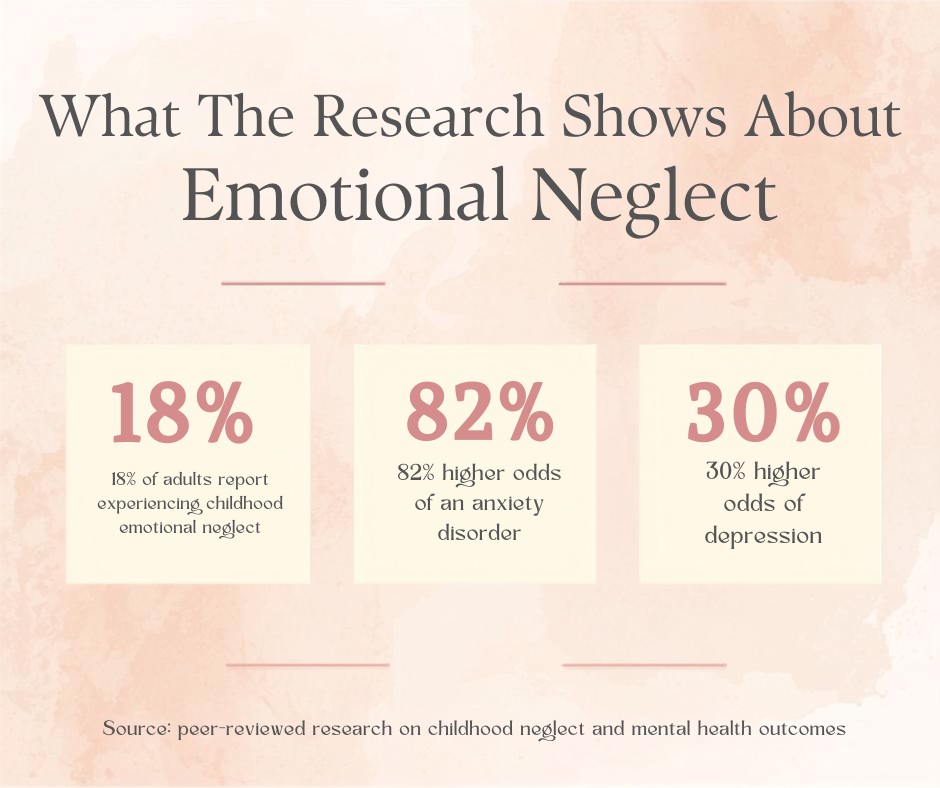
This isn’t just a feeling, either. Research published on PubMed has linked childhood emotional neglect to higher rates of anxiety, depression, and relationship difficulties well into adulthood. If you’ve been carrying this quietly, there’s real science behind why it’s affected you so deeply.
A Few Questions I Get Asked About This
Is emotional neglect the same thing as abuse? Not always, and that’s part of what makes it so hard to name. The APA draws an important distinction: neglect is an act of omission, failing to provide comfort or attention, while abuse is an act of commission, an active harm. Emotional neglect is often an absence, a lack of attunement, acknowledgment, or safety, rather than a single harmful act. That doesn’t make it any less real or any less worth healing from.
Can emotional neglect happen in adulthood, not just childhood? Yes. While a lot of the conversation focuses on childhood, plenty of us experience emotional neglect in adult relationships, friendships, and even workplaces, anywhere our feelings are consistently dismissed or expected to stay quiet for someone else’s comfort.
Is this something therapists actually study? Yes. Psychologist Dr. Jonice Webb, who coined the term Childhood Emotional Neglect (CEN), has spent her career researching it and offers a free self-assessment if you want to go deeper into whether this applies to you.
How do I start healing if I don’t even know where to begin? Start with one honest conversation, even if it’s just with yourself, in a journal. Notice where you’re shrinking your feelings to keep the peace. From there, deep listening practices, mindful communication, and often the support of a good therapist are what move this from insight into real healing.
What if the people who neglected my feelings don’t think they did anything wrong? That’s common, and it’s not yours to fix. Healing doesn’t require the other person’s agreement or apology. It only requires that you stop waiting for it before you let yourself feel whole.
What are the most common signs of emotional neglect? They tend to be quiet rather than dramatic: apologizing for your own emotions, feeling guilty for needing support, being the one who always listens but rarely gets heard, and struggling to name what you feel in the moment. If you want the fuller list, scroll back up to the signs of emotional neglect section above.
Where to Go From Here
If any of this sounds familiar, please hear this: your feelings were never the problem. The people who couldn’t hold them were. If you are only now recognizing emotional neglect in your own life, healing from emotional neglect starts exactly here, with the recognition itself.
You don’t have to have all the answers today. Start small: notice when you’re shrinking your own feelings to keep someone else comfortable. Practice sitting with someone, or letting someone sit with you, without either of you rushing to fix or shut it down. If you want a gentler daily practice to build on this, Self-Care in Real Life has practical, doable places to start. And if you’re ready to go deeper with a professional, BetterHelp [affiliate link] makes it easy to find a licensed therapist who can help you work through what you carry, on your own schedule and from home.
Wholeness, in some capacity, awaits you. You are worthy of feeling good and whole again. My Self-Love Workbook was built for exactly this kind of healing, and Optimal Health and Wellness guide rounds it out from a mind, body, soul view if you want the fuller picture.